Showing posts with label May 2012. Show all posts

Sunday, May 20, 2012

Smithsonian Exhibit on the National Museum of African American History and Culture

Where: Smithsonian Castle

When: through May 20, 2012

This exhibit opened Wednesday and closes today, for reasons that escape me.  I would think that there would be a fair amount of interest in the plans for the new African American museum and that visitors to the current museums would be eager to see what will be available to them should they choose to come back to DC in a few years.  Oh well, I check the exhibit listings frequently for exactly this reason - so that I don't miss something good that's only around for a short time!

The new museum was in the design process for four years, will be located at 14th Street and Constitution Avenue (on the other side of the American History Museum) and will open in November 2015 - in other words, it will be a while yet before I'm blogging about shows I see there!  Outside of the museum, there will be an area called a "reading grove."  I don't know exactly what this is, but I like the sound of it.  It appears that the entrance to the museum will lead to a large open space, which reminded me of the American Indian museum.  It also seems that a really impressive water feature will be part of the design, and since I'm a sucker for a good fountain, I was glad to see this.

In addition to the plans for the museum, results of recent excavations were also on display, mostly pottery and some glass shards.  I could not help but be reminded of the Riseholme Museum described by E. F. Benson in his novel, Lucia in London - filled with items that the characters no longer wanted, but couldn't bring themselves to discard.

Verdict: One can only hope that perhaps this exhibit will appear again, closer to the time of opening - it's a wonderful way to whet one's appetite for the exhibits to come.

Monday, April 30, 2012

Not really worth the wait

The rest of the "Dark Matters" exhibit finally opened again.  I'd been back a couple times and been confronted with the same barrier to the show.  I asked at the information desk what was going on, and it turns out there was water damage.  Perfectly reasonable that they would need to close part of the show, but why couldn't they put up a sign?  Why was there no announcement on the web site?  Why not have an idea of when it might reopen and communicate that to people?  Oh well, it's the Hirshhorn - what exactly was I expecting?

Now the show is open again (good thing, as it closes in just a couple of weeks), and I can offer my views on the entire exhibit.  Frankly, my first thought was, "that's it?"  In addition to the two offerings in the first room (that  I reviewed in an earlier post), there was only one other room.  It had maybe six items in it.  I find it difficult to believe that there are so few items in their entire collection that deal with darkness, but why go to the trouble of setting this up if you're not going to use all the resources at your disposal?  Baffling.

The items I liked best were a series of photographs called "Some Thames - Group M."  I like the idea of seeing "some" river; I assuming there are other groups as well.  The colors change from shot to shot, which is interesting.  Roni Horn is the artist.  It was also good to see "Untitled (Big Man)" by Ron Mueck.  I've always referred to this piece as naked fat man, which I think gives you an excellent idea of what you'll be seeing if you stop in.  He's not dark in the sense of swarthy; in fact, he's pretty pasty white, but he does look distinctly unhappy, so his darkness is one of mood.

Verdict: If you're at the Hirshhorn already and you've got a few minutes to kill, have a look.  Otherwise, if you miss this, you're not missing much.

Saturday, April 14, 2012

Goryeo Buddhist Paintings: A Closer Look

Where: Sackler Gallery

When: through May 28, 2012

This is a very small exhibit - only three paintings, which are Buddhist icons created in Korea in the 14th century.  Although the works were acquired by the Smithsonian 100 years ago, they have never been displayed together before.

These icons were inspired by Chinese art of the period and were intended for close viewing in an intimate setting.  The artists painted on both sides of the silk - a reminder of the Jakuchu show at the National Gallery!  The icons were intended to provide a promise of salvation to the viewer; those needing to be rescued from hell in the afterlife could turn to Kshitigarbha, who possesses a wish-granting jewel.

There are only 150 Goryeo Buddhist paintings in the world, and when these pieces were purchased, they were believed to be Chinese or Japanese.  Only through on-going study was the truth discovered.  Sadly, the years have not been kind to these works; they are much darkened and the details are difficult to make out.  Luckily, Buddhist painting specialist Chung Woothak has made a photographic study of the pieces, and the video on display shows the details that are no longer visible on the originals.

Verdict: Easily managed in a lunch hour and interesting to see a show on Korean art; it occurs to me that I don't think I've seen one before.  You could pair it with the Minouk Lim video that's still playing in the foyer.

Saturday, April 7, 2012

Annie Leibovitz: Pilgrimage

Where: American Art Museum

When: through May 20, 2012

One might expect to head to the Portrait Gallery side of the museum to see an exhibit of Annie Leibovitz works, but this show is not a typical Annie Leibovitz show.  These are not obviously portraits; the photo of Niagara Falls pictured here is illustrative of what you will see.

Yet, I think you could look at these photographs as portraits, although the subjects of the works are not pictured.  Leibovitz took these photos of objects associated with two dozen people who were influential to her and her work.  For example, she has a photo of Elvis Presley's motorcycle.  The exhibit notes state that these photographs construct a portrait of Leibovitz herself, as she seeks to portray the qualities of character she admired in these people, she creates a picture of herself.  I was reminded of a conversation I'd had with a friend about how one's book collection is autobiographical.  The books you have, the ones you keep, the ones you display on a book shelf in a public room of your house tell something about you.  These photographs do the same thing for Leibovitz.

In addition to the photographs of objects belonging to particular people, photographs of places are included as well.  They are, in effect, pictures of what influence all of us, the common cultural legacy we all share.

I was struck by a photograph of the hands from the Lincoln Memorial - modeled on Daniel Chester French's own hands, a picture of Eleanor Roosevelt's cottage at Val-Kill, (and reminded of the White House decorative arts display, which had a piece of furniture from Val-Kill) and a mention of Annie Oakley, who participated in Buffalo Bill's Wild West Show - how many references to that show have I seen since I saw that exhibit of Native Americans who performed in it?  Too many to count.

Verdict: A nice show, not overly large, easily managed in a lunch hour.

Sunday, April 1, 2012

Three small exhibits at the Portrait Gallery/Museum of American Art

Mementos: Painted and Photographic Miniatures, 1750-1920 

Where:  National Portrait Gallery

When: through May 13, 2012

Originally, miniatures were very small images or portraits, the 18th century equivalent of the wallet-sized photo.  They were kept in jewelry: pendants, brooches or bracelets.  By the 19th century, they were slightly larger pieces.  In the 1840s, small daguerreotype artists did both paintings and daguerreotypes, and in the 1860s, miniature paintings had fallen out of fashion, as photographs were less expensive to purchase.  In the early 1900s, however, they enjoyed a revival and many of the most successful miniaturists were women artists.

Many of the miniatures on display are of famous Americans, including Charles Brockden Brown, American's first literary professional (I confess, I'd never heard of him and had to look him up - turns out he was a very popular writer of the early National period), Abraham Lincoln, of whom we see two miniatures: an ambrotype by Mathew Brady and a watercolor by John Henry Brown and Chief Thundercloud of Buffalo Bill's Wild West Show (of course, I was reminded of the show a while back at the Ripley on the members of that show).  Also included is James Smithson, without whose generosity, I most likely wouldn't be looking at the exhibit at all!

Memories Arrested in Space

Where:  Archives of American Art

When: through May 15, 2012

Just a few steps down the hallway from the miniatures exhibit  is the room which houses the "show" area of the Archives of American Art.   It's a reminder that along with all the items on public display, the Smithsonian owns an enormous number of other items, including the papers of many American artists.  One of these is Jackson Pollock, and this show is in celebration of the centenary of his birth.  Pollock, a leading figure in Abstract Expressionism, was a controversial figure, with many admirers and detractors.  He seems to have been a man of great talent, who sadly, was never able to fully control his alcoholism.  His art is not necessarily to my taste, but I can appreciate that it took talent to create, and the thought that someone's inner demons will not leave them in peace to create is a shame. A quote of his stuck with me, "People have always frightened and bored me..."  Spoken like a true introvert - I can relate.  His papers were donated by his wife,  and I think it's laudable when spouses or children take the care to donate valuable items to an archives or museum that can take care of and display them properly.

One Life: Ronald Reagan

Where: National Portrait Gallery

When: through May 28, 2012

Let me be honest up front: Ronald Reagan is NOT my favorite president.  I actually debated whether I should even go to see this show; I could feel my blood pressure rising just thinking about it.  In the end, my anal retentive determination to see everything, whether I thought it sounded good or not, won out, and I went to see it.

If you like Reagan, you'll love this show, as it is certainly a celebration of his life, rather than a critical examination of his policies and their consequences.  The thing I took away from it was the many ways in which Reagan, now practically raised to sainthood by the hard right, deviated from their policies while in office.  He raised taxes!  He enacted pollution control laws!  He bargained with the Russians!  Much of that seems to have been forgotten now.  Setting aside my views on the man, the show, like all of the entries in the "One Life" series is very well done.  Kudos to the Gallery for putting on these shows about important Americans.

Verdict: All of these shows are worth seeing, and they can be managed all together if you don't have much of a walk to the National Portrait Gallery/Museum of American Art.  Note that the miniatures exhibit is in dim light, although brighter lights pop up over the paintings so you can see them better.  The Pollock papers are interesting, more so perhaps, if you are a fan.

Sunday, March 25, 2012

Dark Matters: Selections from the Collection

Where: Hirshhorn Museum and Sculpture Garden

When: through May 13, 2012

Oh, Hirshhorn.  I try to like you, I really do, and then you go and annoy me to pieces.  Why must it always be this way with you?

I went to see this show, which is supposed to be a collection of Hirshhorn pieces from the last 60 years all dealing with darkness.  I was promised a wide selection of pieces that would include items from many genres and artistic movements.  What did I actually see?  One room, containing a couple of pieces, including a piece by Joseph Beuys entitled F.I.U. Blackboards which was two black panels with a bucket containing water and a rag in front of them.  Setting aside my desire to roll my eyeballs at that great work, I looked in vain for the rest of the show.  Surely there must be more than this?  I walked all over the lower level, but to no avail.  I finally asked the guard in the room with the pail, and she said this was all there was right now.

Seriously?  This show has been up since last month - why have most of it closed off?  And if you need to close the show, why not let people know that?  I'll have to try again another day, but "Suprasensorial" aside, you're not winning me over, Hirshhorn; you're just not.

Verdict: I can't really evaluate the show based on only two pieces, but I'd make sure I had something else to see before venturing over there.

Vochol: Huichol Art on Wheels

Where: National Museum of the American Indian

When: through May 6, 2012

I wish this would have been on display when I went to see the show on Quileute Wolves, as it would have been easy to combine them in one visit, but, no such luck.  This is worth a trip on its own, however, just because when else are you likely to see a bead covered car?

This is, quite literally, just that: a Volkswagen Beetle, covered in beads.  Two families from Mexico spent more than seven months working on this piece, which took 9,000 hours to complete and used over 2,000,000 beads.  Both the interior and exterior are beaded and the colors are wonderful.  Vochol is a combination of the Mexican name for the Beetle and the name of the craftsmens' tribe, the Huichol.  The work is amazing and is eye-catching to say the least, which is the point, I think.  It draws attention to the intersection of traditional and modern cultures, so often fraught with misunderstanding and distrust.

Verdict: Don't miss it - it's right in the lobby of the museum, so you can stop in, even if you're just walking by and only have five minutes to spare. 

Suprasensorial: Experiments in Light, Color and Space

Where: Hirshhorn Museum and Sculpture Garden

When: through May 13, 2012

Believe it or not, this is an exhibit at the Hirshhorn I really liked.  Usually, I'm fed up with their shows of pretentious non-art - pieces I could have created in my garage, given a 2x4 and a gallon of paint.  This show, however is really good and well worth seeing.  It consists of the works of several Latin American artists, rarely exhibited, that were originally created in the 1950s - 1970s.  Although they came from different countries and worked in different time periods, they all tried to give viewers an experience beyond passively looking at art - in each piece, in one way or another, you become part of it - you "walk into" it.

It's several large installations, so although it covers a lot of ground, you're only seeing a few things.  I find I take my time more if I'm only looking at a half-dozen items and have a much more thoughtful experience.  Usually, I've got lots to see and only a limited amount of time, so I'm rushing through shows, perhaps having time to go back and look at something I really liked, but perhaps not.  This show allows you to spend plenty of time with each piece, so you really see it.

The first piece (not my favorite) is actually displayed over the top of the escalator.  It's a set of illuminated tubing arranged in a circular pattern on the ceiling.  Although it's neat to ride up the escalator looking at the tubing emerge and neat to ride down and see it vanish, I think the location is more impressive than the art itself.  Illuminated tubing doesn't really do much for me.  Lucio Fontana created this piece of neon sculpture for the IX Triennial of Milan in 1957.  It was refabricated in 2010.  I don't know what that means - refabricated - but I have a sneaking suspicion that someone found the tubing in a box and reassembled it as best they could.  Perhaps I'm too cynical.

The same artist, in the next exhibit space, painted monochromes and then slashed them open.  I gather this is supposed to bring the viewer into the work, but it leaves me cold.  Monochromes, really?  How is this art?  I can do this.  And, if you give me a box cutter, I can slash this stuff open too.

In the same space, is a far more interesting piece entitled Three & One by Jesus Rafael Soto.  It's really difficult to describe; I tired looking for images on the web, but none of them really convey the work.  It's 3-D - a grey background with black stripes with strings in front holding strips of nylon.  It sounds like nothing, but is great to see in person.  Another of his works, Eight Silver is in the same room - it's boxes that project from a background - as you look at the piece, it seems as if the boxes are moving - again, I can't describe it - trust me, it's very cool.

The next installation is Light in Movement, which was originally done in 1962.  I can see that this would have been interesting then - it's a room with a mirrored wall with lights reflecting off moving pieces of metallic material (paper, maybe?) that you walk through.  If you remember the disco balls of the 1970s, you've seen this before.

The next installation is Chromosaturation, which was a bit of a disappointment.  I walked past three rooms that were filled with color - one room was red, another yellow and the other was either blue or green.   I then realized that you could walk through the color saturated rooms, after putting special footwear on so as not to dirty the floors.  I thought I'd be walking into a room of color, but no such thing.  When you're in the room, you just see it as white - it's when you're outside looking in that the colors are really visible.  My rule: if you're going to make me look ridiculous in oversize slippers, I better get something out of it.  If you go to the show, skip this part.

The exhibit completely redeemed itself with the final two installations.  The first was another offering from my new enthusiasm, Jesus Rafael Soto, called Blue Penetrable BBL.  It's pictured above, so I won't describe it, except to say that you get to walk through it - it's really okay to touch the art.  As you walk through, you feel surrounded by "blue-ness" meaning not sadness, but simply by the color blue.  Watching other people walk through is also part of the fun.

The last installation was Cosmococa - Program in Progress, CC1 Trashiscapes which means I know not what, but is a room filled with big cushions and pillows on which you sit or lie down.  In the room, video images flash on the walls and music is playing.  It's not so much that the images themselves are of any great interest; it's watching how other people react to them that makes this so great.  When I was there, I saw a young couple holding hands and an older couple, making use of the room to rest from what I assume was a long day of museum visits.  The person I remember best, however, is a young girl - maybe 12 years old, who was dancing to the music.  Clearly, she had studied ballet, as her movements were very precise and her exuberance was quite contained.  Every time the music changed, her dance changed slightly, as well.  I enjoyed watching her very much - it's a pity she's not there all the time.

Verdict: Rare as it is for me to recommend a Hirshhorn show, I'm going to recommend this one - great fun.

Saturday, March 17, 2012

Behind the Scenes: The Real Story of Quileute Wolves

Where: Nation Museum of the American Indian

When: through May 9, 2012

Unbeknownst to me, the Twilight series of books (which I have never read) feature a character who is not only a werewolf but also a member of the Quileute tribe.  The tribe seems to have a love/hate relationship with the books, on the one hand, they bring lots of tourists (and tourist dollars) to their area, but on the other hand, they encourage misconceptions about the tribe among those who read the novels.  This exhibit is an attempt to set the record straight.

The tribe does have a strong bond with wolves, so one can see where the Twilight author would have gotten the idea for a Quileute werewolf character.  The tribe creation mythology involves wolves, and there is a society of men within the tribe that is associated with wolves.  They are not, however, werewolves.  On display is some tribal art, both some fine carvings done by adults and remarkably detailed drawings of tribe rituals and ceremonies done by children in the schools set up in the early 1900s.

Verdict: This is a relatively small show, so it's easily managed in a lunch hour.  I would like to have seen more carvings, as the ones on display were quite impressive.

"Something of Splendor": Decorative Arts from the White House

Where: Renwick Gallery

When: through May 6, 2012

I wasn't sure what to expect when I went to see this show, and I wasn't relishing the long walk over to the Renwick and back (which eats into the time I have for exhibit viewing), but in the event, it was a wonderful show and a wonderful day for a walk, so it couldn't have been a better trip.  Washington, DC is having an early spring - the cherry blossom trees are flowering as I type, a good two weeks earlier than normal.  The White House area was decked with Union Jacks and American flags to greet Prime Minister Cameron who was paying a visit, making for a festival atmosphere at Lafayette Park.

The show itself is great - lots of furniture, serving pieces and other decorative items from the White House.  It's quite interesting to see how tastes have changed in the last 200+ years.  The show celebrates the 50th anniversary of the White House Historical Association, and many of the pieces have never been seen outside of the White House before.

I learned that the Theodore Roosevelt administration saw an extensive renovation of the White House, giving the reception rooms their current look.  The highlight of the show for me was seeing one of the Gustav Stickley bookcases that Edith Roosevelt bought to display some of the White House china, the precursor to the China Room.  I love Stickley furniture, and I don't think I've ever seen a real original Stickley piece before.

Jackie Kennedy initiated an ongoing museum program to preserve the White House's furnishings and decorations, so we have her to thank for this collection.  One of the most interesting items on display is a small box, lined with wallpaper from the Madison administration, picked by Dolley Madison herself.  This is one of the few things left from the original White House, which was burned by the British during the War of 1812.

I very much liked the Lincoln china pattern, several pieces of which were on display.  The accent color is a reddish-purple, new at the time.  It makes a nice change from the seemingly endless blue pieces.  Another interesting piece is a coverlet for the bed in the Lincoln bedroom, made by Grace Coolidge.  Her hope is that future First Ladies would each make something for the house, but to date, she is the only person to have done so.  There is a piece of furniture made at Val-Kill, the factory on Franklin Roosevelt's estate, Hyde Park.  Eleanor Roosevelt brought the piece to the White House.

A fun fact: the Benjamin Harrisons were afraid of electric light - the servants had to turn the lights on and off for them.  That's what I love about going to these exhibits - you learn so many odd little things.

Verdict: This is a show well worth the time to see.  Fun, interesting, educational - something for everyone.

Saturday, March 10, 2012

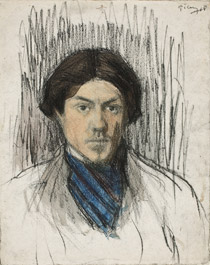
Picasso's Drawings, 1890–1921: Reinventing Tradition

Where: National Gallery of Art

When: through May 6, 2012

According to the exhibit introduction, Picasso was one of the world's greatest draftsmen.  I'd always thought of him as a cubist painter whose work I didn't much appreciate, but this exhibit shows another side of his work, one I liked rather more.

This show features drawings from the first three decades of his career; the first offering is a drawing of a statue of Hercules owned by his family.  I thought it wasn't bad, until I read that he was nine years old when he drew it!  Really, really good for a nine-year old.

The still lifes on display are quite linear; you can see the cubism emerging.  The two pieces I liked the best ("Bottle and Wineglass" and "Composition with a Violin") were both done in 1912.  There's an Art Deco feel to both of them that appealed to me very much.

This is a much smaller show than I had anticipated; it's only three rooms, and so easily managed in a lunch hour viewing.  Because Picasso's style changed so much over the course of 30 years, there's a wide variety of genres on view here.  It's got something for everyone!  My only complaint is that it's also very popular, so expect to share your experience with many of your closest friends. 

Verdict: Go see this show for another look at Picasso - it's time well spent.