Showing posts with label Natural History Museum. Show all posts

Monday, May 1, 2017

All About Color

Where: Natural History Museum

When: through May 15, 2017

This is a display on the lower level of the museum, put up by the Smithsonian Libraries.  These are usually in two facing display cases, on either side of the hallway between the restaurant and the gift shop.  Amidst all the hustle and bustle, they usually don't attract a lot of attention, and I have the exhibit to myself.

Color is scientific and artistic, historical and cultural - a little something for everyone.  We have Sir Isaac Newton to thank for the color spectrum, a building block of scientific achievement.  Did you know that peacock tail feathers have no color pigment?  Their appearance is a trick of the light.  That fabulous red-orange Fiestaware color that you don't see anymore?  It contained uranium oxide, which
made it slightly radioactive.  Learn all this and more!

Verdict: A small informative display, worth a look as you head off to one of the other exhibits.

Saturday, January 31, 2015

Orchids: Interlocking Science and Beauty

Where: Natural History Museum

When: through April 26, 2015

There's no better way to beat the winter blues than by visiting this exhibit on orchids at the Natural History Museum.  In odd-numbered years, the show is here; in even-numbered years, it's at the Botanic Gardens, close to the Capitol building.  On a dreary January day this week, I headed off to get a dose of warm, fragrant relief.

Each year, there's a different theme for the display; this year, the focus is on the science of the flowers - how botanists learn more about them, how breeders (if that's the right word) create hybrid flowers to appeal to fanciers and how the flowers are protected for future generations to enjoy.

The Smithsonian has over 8,000 orchid specimens in its greenhouses in Suitland, Md., a part of the Institution you don't get to see.  Of course, you can enjoy the products of their labor at the Smithsonian Gardens on the Mall, but I confess, I'd like to visit the greenhouses and see where it all begins.

There are a large number of different varieties on display; one, Psychopsis Mariposa 'Mountain' is in the shape of a butterfly.  I think my favorite was Oncidopsis Stefan Isler 'Lava Flow' which has a lovely color combination of a dark red and orange.  I overheard one of the orchid experts who are available to answer questions tell another visitor that the orchids are swapped out each week, so you can go back multiple time and always see something new.

Verdict: If you're like me and need a day-brightener this time of year, make sure to see this lovely display.

Sunday, September 28, 2014

A visit to the Sant Ocean Hall

Where: Natural History Museum

When: Fall 2015

I took a stroll over to the Natural History Museum this week, as much to enjoy the delightful weather as to see anything in particular.  There are three small exhibits in the Sant Ocean Hall that I glanced over, and they're worth checking out if you happen to be in the museum anyway.

The first is "Portraits of Planet Ocean: the Photographs of Brian Skerry."  If you like nature photography, this is a delight.  It focuses on underwater life, as you might have guessed from the title and is a reminder that what lies beneath the surface of the ocean is remarkable.

There's also a small case providing information on the Census of Marine Life.  This project involved scientists worldwide and provided the opportunity to obtain, for the first time, a baseline picture of the ocean.

Finally, another small display showcases the work of artist Cornelia Kubler Kavanagh, whose work is inspired by tiny ocean pteropods, or "sea butterflies."  As small as a grain of sand, they are threatened by ocean acidification.  Her work is abstract, but based on forms found in nature.

Verdict: When you're next in the Sant Ocean Hall, don't miss these small, but interesting, displays.

Saturday, August 16, 2014

A Tale of Two Exhibits

Yesterday, I took myself to the Natural History Museum, intending to see two exhibits.  One was the interactive "Walk Among Dinosaurs!" and the other was "Once There Were Billions" about several species of extinct birds.  For all the hype about the ability to "meet" dinosaurs, the real star of the show is in the basement, with nary a sign to guide you to her.


Where: Natural History Musem

When: through September 2, 2014


What could be more exciting than seeing yourself face-to-face with prehistoric creatures?  You can "pet" them and make horror-struck faces and swerve to avoid being eaten.    Somehow, though, the whole thing fell flat.  The movie technology is fine, and I think the small kids in the audience enjoyed themselves, with the help of some fun-loving dads, but this just isn't my thing.  Perhaps you get what you pay for with these "augmented reality" displays, and since I paid nothing, well, you get the idea.

I appreciate that the museum has a big problem right now.  The dinosaur area, one of their most popular exhibit halls, is closed for a long time, and although it will doubtless be greatly improved when it re-opens, at the moment, they're scrambling to find something to fill this gaping void in their offerings.

Verdict: If you've got little kids, by all means go see this, as they'll doubtless enjoy themselves.  Adults can probably give this walk a pass.

Where: Natural History Museum

When: through October 2015

The second exhibit I saw was about as unlike the dinosaur walk as it is possible to imagine.  There are two big display cases next to the gift shop by the Constitution Avenue entrance, and the Smithsonian Library uses them to put up displays.  They tend to feature books from the Smithsonian holdings and artifacts from their warehouses.  Where the dinosaur walk used cutting-edge technology, this is heavy on text, and those display cases have been around since I was a child (possibly longer).

This display provides information and specimens of extinct bird species.  It is, in fact, all the info I had wished for when I saw the bronzes of these birds outside the museum and in the Haupt Garden.  Why, why is there no indication that this exhibit is here on the plaques identifying the statutes?  Just a few lines saying something to the effect of: if you're interested in these species and how they became extinct (spoiler alert: it's people), go see the display "Once There Were Billions" on the ground floor of the Natural History Museum."  How hard would that be?

Correction 8/23/14:  As it happens, I was in the Haupt Garden this week, and I saw that they do reference the "One There Were Billions" exhibit on one of the informational plaques.  So I take back my criticism for the lack of cross-referencing.  The rest of my rant stands.

If it were only a matter of a lack of cross-referencing, I would just shake my head and move on.  I've seen this before in the American History museum.  Come on people, help the tourists out.  They come for a day, they don't know exactly what you've got, give them some information so they can see things that interest them.

But it's not just that.  In this display case, is Martha, the last passenger pigeon, who died in (I think) 1914 in the Cincinnati Zoo.  I don't mean it's a model of her, or a photograph; I mean it's actually her.  Her body was stuffed after she died, and she belongs to the Smithsonian.  Usually, she's in a climate-controlled cabinet somewhere, far from the museum itself, but until October 2015, she's on display.  The last passenger pigeon!  And you can see her!  This should be big news; they should be promoting this all over their website and with big signs when you walk in.  Instead, nothing.  If I hadn't been reading the notes in the display case carefully, I would have missed her entirely.

What were they thinking?  If you're going to pull a specimen of this level of historical significance out of storage, why not make a big deal out of it?  Make Martha the centerpiece of a big display on extinction and the need for conservation.

Verdict: Go see this.  It's informative, it's small enough that it's easily managed in a lunch hour, and you can see the last passenger pigeon.

Saturday, July 5, 2014

Beyond Bollywood: Indian Americans Shape the Nation

Where: Natural History Museum

When: through August 16, 2015

You'll notice from the closing date that I'm well ahead in my viewing of exhibits.  Far from missing anything, I'm in danger of running out of shows to see!  Happily, the Smithsonian and National Gallery are always adding additional shows, so I'm sure I'll be able to keep viewing and blogging for the foreseeable future.

This show, which you have an abundance of time to see, is concerned with the impact of Indian Americans on the U.S.  I should make clear at the outset that we're discussing Indians from India, not Native Americans.  In fact, on display is a series of photographs entitled "An Indian from India" by Annu Palakunnathu Matthew, an Indian-America who reflects on the similarities in how the British looked at Indians, and how Americans viewed their own "Indians."  She takes photographs of herself, in the same poses as Native Americans - the similarities are striking.  This was an interesting set of photos to see, right after having seen the "Indelible" show at NMAI.

The story of Indians in America is one of immigration.  Some came directly to the U.S., others came through other British territories with Indian enclaves.  A small suitcase, holding the possessions Indians brought with them from their homeland, reminded me of Camilla's Purse - in both cases, a container to hold those items that were most precious to the owner.  Now, one out of every 100 Americans can trace their ancestry to India; there are 121,000 in the D.C. area alone.

Indians were seeking freedom from British rule, which you would have thought would have endeared them to Americans, but no such thing.  Caught up in the discrimination against the Chinese, Indians were included, along with all other "Asiatic nations" in the Chinese Exclusion Act.  There were anti-Indian riots in Bellingham, WA in 1907 - within two weeks, the entire Indian population had left.  Indian women were discouraged from immigrating; I guess the hope was that this would prevent the production of more Indians.  Of course, the Indian men simply married members of other immigrant groups.  It was only in 1980 that the Census included Asian Indian as a racial designation.

The exhibit highlights the different occupations to which Indians have flocked in numbers; one of them was medicine.  In addition to photographs of actual doctors and other medical professionals, both Kal Penn and Mindy Kaling are featured.  Surely, the museum knows that they are not actual doctors, but actors portraying doctors?  I confess, although I have nothing against either one of them (I loved Mindy Kaling in "The Office"), I found it a bit disconcerting to see them in this section.

Perhaps my favorite fun fact in this display is that the most popular representation of Indian Americans is Apu, the manager of the Kwik-E-Mart on "The Simpsons."  Although there's no picture of him, or even better, video of one of his classic exchanges with Homer or Bart (copyright issues perhaps?), I was reminded of him and smiled.

Verdict: This is a very interesting exhibit.  I learned a lot about Indian Americans, their history in this country and their cultural impact.  I would recommend devoting a trip to this show, as it's large enough to take up a lunch hour.

Sunday, April 27, 2014

The Rex Room

Where:  Natural History Museum

When: through October 20, 2014

Since I went to see The Rex Room, I've been trying to think what I might find worse than having to do my job while thousands of strangers gawked at me through a glass wall.  I suppose having no job at all would be worse, but being on display like an animal at the zoo is plenty bad.

My brother and sister-in-law are both scientists, and they tell me that paleontology is the glamor field.  All the money and attention flows in its direction, so I guess having to be on display is the price those who study dinosaurs pay for fame and fortune.  Still, I was happy to return to my backwater library when my lunch hour was over - able to work my research magic far from prying eyes.

As I suppose I should have mentioned at the beginning of this post, the Natural History Museum has just taken possession of a T. Rex.  When the dinosaur hall re-opens in 2019 (which seems like forever from now), it will be the star of the show, but at the moment, it's a long way from being ready for its close-up.  The scientists on display are cataloging and studying each piece of the skeleton prior to shipping it to Toronto to be mounted.

Some background on the T. Rex, in case you've not been following this story, 66.5 million years ago, this dinosaur died, near a river in what is now Montana.  River sediment covered the carcass and over the years (many, many years) the sediment turned to stone, encasing the T. Rex.  In 1988 Kathy Wankel, a Montana rancher, was hiking, and spotted a bone protruding from the earth.  She brought it to the Museum of the Rockies, who took a lively interest in her discovery.  It took them two years to fully excavate it, and on April 15, 2014, it arrived in a FedEx truck at the Natural History Museum.

This fossil has already provided information to researchers on dinosaur growth, life span and reproduction, and the hope is that it will yield answers to even more questions.  Like: why did T. Rexs have such little arms?

Verdict: I felt a little guilty staring at the scientists, but their work is interesting.  Starting next week, this will be on the only dinosaur on display, so join the line and gawk away.

Sunday, February 2, 2014

Saying Goodbye to the Dinosaurs

Where: Natural History Museum

When: through April 28, 2014

I went over to Natural History this week in order to take one last look at the exhibits on dinosaurs and fossils before they close for the foreseeable future.  The entire area is getting a massive renovation, which won't be complete until 2019.  As much as I hate to see such a big and crowd-pleasing part of the museum close for such a long time, this area is in desperate need of a makeover.

This is not the dinosaur exhibit that I remember from childhood, but one that was opened in 1981.  As much of an improvement as this doubtless is over what was there before (my memories are a bit dim, since we're talking some 40 years ago), compared to the museum's newer areas (the Sant Ocean Hall, the Hall of Mammals, the exhibit on human origins), this is dull in the extreme.

The colors are drab, the notes are dense paragraphs of hard-to-follow text and the displays are row upon row of fossils.  What should be a fascinating display of the earliest forms of life on earth are just, well, boring.  The wonderful text notes are the things I miss most - the easy to read and understand explanations in some of the newer areas are not here, and they make a huge difference.

Even the dinosaurs, which are anything but dull, are jammed together in a tight space - I'm hoping the redo will allow the museum to spread these out, so you can see each specimen on its own.  The money for the refurbishment is coming from the Koch brothers, who bankrolled the dinosaur display at the Museum of Natural History in New York.  I've heard that  exhibit is excellent, so I've got high hopes for what the end of the decade will bring us.

Verdict: Go to see this area of the museum (there are five different sections covering fossils generally and dinosaurs specifically) before it closes.  Then you can wait patiently for the new display!

Wednesday, January 1, 2014

Nature's Best 2012 Photography Awards: Windland Smith Rice International Awards

Where: Natural History Museum

When: through March 4, 2014

The Natural History Museum displays the winners of this competition every year.  If you like nature photography, this is a must see exhibit.  I always look forward to seeing this - it never gets old.

I think what makes it so appealing, in addition to the fantastic photography, is the display itself.  All the pictures are in large format, so you feel as if you're drawn into the picture.  They also use top-quality paper and printing, so these are the best photos you can see.  The colors are just spectacular, and there's a wide range of subject matter.

It's hard to pick a favorite photo, but I think mine was the one of the gorilla mother and baby.  The mother was looking at a magazine, with a photo of her baby.  A great moment, captured beautifully.

I looked up some information on Windland Smith Rice.  She was a nature photographer, as well as a mentor to others in the field.  Sadly, she died at age 35, of a disease that affects athletes (she ran triathlons).  This competition is held in her name to honor her memory.  I'm very sorry for her family's loss, and this is a wonderful way to remember her.

Verdict: Don't miss this display - easily managed in a lunch hour.

Saturday, December 7, 2013

Whales: From Bone to Book

Where: Natural History Museum

When: through June 15, 2014

On the Ground Floor of the Natural History Museum, quite close to the Constitution Avenue entrance (tip: much less crowded than the Mall entrance), are two large display cases that have exhibits in them.  I suspect, although I don't know for sure, that these are done by the staff in the Smithsonian library, as they often focus on books, or the history of the museum's collection.

I don't know that I've ever seen anyone else looking at these, so they remind me of the exhibits from the archives at American History.  Since they're right on the main corridor, they're not exactly quiet, but you won't have to stand cheek by jowl with 50 of your closest friends to see what's in the cases.

The current display is on whales - how the museum finds fossils, uses them to gain information about whales and then shares that information with other scientists by publishing, including in the Smithsonian Institution Scholarly Press.  When one thinks of the Smithsonian, one thinks of the museums on the Mall, but there's a vast deal more going on in the organization than just what one can see on a casual visit.

The Smithsonian's collection of whale fossils is the best in the world.  They started collecting in the 1850s and continue to this day.  They collect from every ocean basin and continent in the world.  The size of the specimens makes them challenging to unearth and transport, as you can well imagine.  The Smithsonian Libraries have the most extensive collection of resources (not just books) on marine mammals, and some of them are on display here.  The exhibit features both very old items and pictures of scientists using the latest technology.  The whale drawings brought home the intersection of science and art, which I've noticed in other displays here and at the National Gallery of Art.

Verdict:  Have a glance at the big cases when you're in the museum - not sure it's really worth it for a separate visit.

Sunday, July 28, 2013

Life in the Ancient Seas

Where: Natural History Museum

When: through October 21, 2013

Yet another of the museum's older exhibits is closing, presumably to allow for a refurbished exhibit, although perhaps it's to make room for the new dinosaur hall that's coming in the future.  Whatever the reason, an update to this show is due and would be quite welcome.  It's an interesting display and chock full of information, but compared to some of the museum's newer offerings, it can't help but be overlooked.

This show is concerned with life in the ancient seas, those organisms that lived and died millions of years ago.  It puts our own life spans in perspective certainly, as well as human existence generally.  Humans in our present form have been around for about 200,000 years.  A good long time, you might reasonably think.  The first known creatures in the sea lived up to 540 million years ago.  Now that's a long time.

In addition, ocean life has come and gone over the years; one era comes to a halt and almost all of the species are wiped out.  Then a new era begins with mostly new creatures.  When people talk about "the end of the world," they're really talking about the end of human life on earth.  The earth will keep on spinning and new life forms will eventually appear, even if humans aren't here to see it.

The hall is arranged chronologically, which I must admit is my favorite form of arrangement.  First, we begin with the Paleozoic Era, which lasted from 540 million to 230 million years ago.  Trilobites flourished, then crashed and burned.  They were followed by the machiopods and crinoids and the first reefs were formed.  Reefs are really sea cities, they were built on the remains of earlier habitations and then spread out as they became too crowded.  230 million years ago, there was the greatest extinction in the history of life on this planet.  The display wasn't clear on what caused this cessation of existence, I gather that scientists aren't sure what happened.

Then the Mesozoic Era (230 million to 65 million years ago) followed, with the first appearance of fish, mollusks, reptiles and birds.  More extinction, then the Cenozoic Era (65 million years ago to the present).  In my view, perhaps the greatest contribution of the Cenozoic Era is the arrival of the scallop to the seas, but many other recognizable bivalves and gastropods appeared as well.  The display includes some lovely shells; I'm sure this is a mere scintilla of the museum's total collection.

Verdict: Worth a look if you're in the museum.  Lots of information, presented in a way that's intelligible to the lay person, one of the hallmarks of Natural History.  Also, if you're a museum nerd like I am, it's interesting to compare this exhibit, opened in 1990, with the Sant Ocean Hall, from 2008. 

Friday, April 12, 2013

The Evolving Universe

Where: Natural History Museum

When: through July 7, 2013

Truth be told, I've always had a bit of a problem with the concept of deep space.  When something is so far away that distance is measured in years, I have a hard time comprehending its existence.  I know that deep space exists, I'm not that much of a cretin, but I can't really fathom it.  It seems as distant as a world in a fantasy novel.

Despite the limitations of my imagination, deep space is out there (far, far out there) and this exhibit at the Natural History Museum attempts to explain it to those of us who are not professional astronomers.  Pictures of different types of objects are on display, with straightforward descriptions and beautiful photographs - the one pictured above is typical.  Each of the planets in our solar system has a photograph, which reminded me of the show I saw at Air and Space a couple of years ago.  Frankly, these photos are not as impressive as those were, but yet again, I walked away thinking Neptune is the most beautiful planet.

For each of the different types of space objects, the description tells you how long it takes for light from that object to reach Earth, and what our planet was like at that time.  Some of the light we see today started its journey to us before humans even existed.

The Sun and the Earth were created 4.6 billion years ago, contrary to the (sadly) popular belief that the Earth is 5,000 years old.  And of what is the Earth and all its inhabitants created?  The remains of dead stars.  I seem to recall that Carl Sagan said we are all star stuff, and (no surprise) he was quite right.  Think of it as cosmic recycling.

I would have enjoyed my visit to this show more had there been fewer other visitors, but class field trip season is now upon us, so the place was very crowded.  When I find something difficult to understand, I do better if I can read in silence, but no such luck.  Even though the exhibit space is well off the beaten path, plenty of people managed to find their way back.  Ah well, I try to remind myself that the more people visit, the safer the museum's funding will be.

Verdict: Great photographs of deep space objects, as well as good information.  Crowded, but so is everything at Natural History at this time of year.

Sunday, January 20, 2013

When Time and Duty Permit: Collecting During World War II

Where: Natural History Museum

When: through April 28, 2013

This exhibit is in the other large display case that's been moved from the vestibule.  It focuses on the work that scientists who were serving in the military during WWII and even regular soldiers did in the area of conservation.

The Smithsonian was able to advise the military about the geographic cultures and natural world of the Pacific region when the U.S. entered the war against Japan.  Curators at the Smithsonian encouraged soldiers to explore the natural world and send back specimens when they were able to do so.  Many servicemen found it a welcome break from the stresses of combat and were happy to assist the museum in its quest for items to add to its collection.

Smithsonian scientists themselves served in the military, and they also sent back specimens.  As a result, the Smithsonian developed a tremendous collection.  It became, and remains, a powerhouse in the field of Pacific studies.  One of the scientists specifically mentioned in the exhibit is S. Dillon Ripley, the Secretary of the Smithsonian from 1964-1984, and for whom the Ripley Center is named.  It was interesting to learn a bit more about Ripley, since I've been to shows in the building named for him many times.

Verdict: Well worth a few minutes of your time.  Like the rhino exhibit, it's easy to add this on to a trip to the museum to see a larger show.

Fascinating -- Endangered RHINO

Where: Natural History Museum

When: through April 28, 2013

I feared I'd have another long search on my hands when I went to see this exhibit.  The display cases on the ground floor, by the Constitution Avenue entrance (where the website told me this exhibit would be housed), used to be located right in the vestibule, just beyond the guard stations.  When I headed over to look at the items there, I found the cases were gone.  I headed out into the main area of the ground floor, and found they'd been re-positioned in the hallway by the gift shop.  This is probably a better place for them; they'll get more foot traffic here, as they were off to the side in the vestibule and not so noticeable.

One of the large cases contained this little exhibit on the rhinoceros.  There are five different types of rhinos in Africa and Asia and sadly, all of them are endangered.  Indiscriminate killing in the 19th and 20th centuries led to a terrible decline in the animal's population, but preservation efforts have led to a slight rebound in populations recently.  Poaching and loss of habitat are still very serious threats to the species' survival.   In fact, the rhinoceros is one of the most endangered species on earth.  The Smithsonian Libraries support and enhance wildlife conservation biology, and this display shows several of the books in their collection on the rhinoceros.  The materials in the case are a nice reminder that there's a lot more to the Smithsonian then just the museums.

Verdict: A nice add-on to a trip to the Natural History Museum - you can see everything in the case in about 10 minutes.

Saturday, November 17, 2012

The Beautiful Time: Photography by Sammy Baloji

Where: Natural History Museum

When: through January 6, 2013

Sometimes I wonder why exhibits end up in one museum rather than another.  This show, of photographs by the Congolese artist Sammy Baloji, could have been shown in the African Art Museum, but instead are here in Natural History.  Perhaps it's because the subject is the mines in the Congo?  I'm not sure, but I'd love to know more about how venues are chosen.

In the 1950s, there was a successful copper mining industry, which brought prosperity to what is now the Katanga region of the Democratic Republic of the Congo.  In 1960, the country gained its independence from their colonial rulers, but corrupt governments and mismanagement have led the industry to ruin and the local people's fortunes have fallen with the industry's.

Baloji takes old photographs of Congolese workers and the colonial managers, and superimposes them on current photographs of the area.  The juxtaposition of former wealth and prosperity with current desolation is both a very clever artistic technique and a quite sad commentary on current events.  Kudos to Baloji for his talent, and sympathy to the poor people, who now have very little in the way of industry.

Verdict: An unexpected show at Natural History and well worth a look - it's small and easily managed in a lunch hour.

Titanoboa: Monster Snake

Where: Natural History Museum

When: through January 6, 2013

I took the morning off on Thursday, and saw several different exhibits.  The number of shows closing in January is quite large (I've noticed over the years that this is often the case), and since I'm taking a fitness class three days a week, that eats into my time for seeing shows.  Add in the holidays, with their inevitable gatherings, and I was fearful I might miss something!  Now, I've got a manageable number left to see, so unless the Smithsonian adds a lot of shows between now and the end of the year, I should be able to bring you news of everything with no problem.

My first stop was the Natural History Museum to see Titanoboa, or a model of him/her, anyway.  The story of how the fossils of this enormous snake were found is quite interesting, but I'll let you read about it at the exhibit, or watch it on the Smithsonian Channel (available on YouTube).  The Reader's Digest Condensed Version of the story is that scientists were excavating in Colombia and found what they thought were crocodile vertebrae.  They sent them to Florida, where other scientists were examining them, and it was discovered that some of the bones were actually from the largest known snake in world history.  Modern snakes are nothing in comparison; this thing was longer than a school bus and weighed more than ten heavyweight wrestlers.

The curators have set up the show very nicely - in the front, there's lots of information about the dig, and the discovery; it's not until you get to the very back that you see the model they've constructed of the snake itself.  Big is not the word.  I was reminded of the basilisk from Harry Potter and the Chamber of Secrets.  I'm not afraid of snakes and have nothing against them, but I really would not want to encounter a live version of this monster!

Verdict: Don't miss this opportunity to learn about the creatures of the rain forest in the Paleocene Era, witness the cooperation among scientists to come to conclusions about their findings and see a model of the biggest snake ever.

Saturday, July 7, 2012

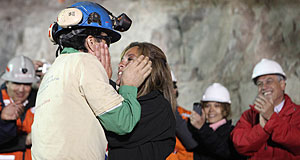
Against All Odds: Rescue at the Chilean Mine

Where: Natural History Museum

When: through September 30, 2012

This is a great exhibit to see when you need to have your faith in human nature restored.  I'm sure everyone remembers the story of the miners trapped for nearly two months in a collapsed mine in Chile and the effort that went into rescuing them.  On display here are one of the rescue capsules used in testing, some of the items the miners used while trapped and lots of information about Chile's mining industry and copper mining generally.

This exhibit is in the back of the Gems room, an odd place I thought, until I remembered that the room is Geology, Gems and Minerals.  I learned that there is a lot of copper in Chile; it contains one-third of the world's supply of copper.  Mining is the backbone of the Chilean economy, and the world's increasing use of electronics has only increased the demand for copper.

The particular mine in which the men were trapped had been in use for over 100 years, and had been weakened by the mining that had gone on before.  Unlike coal, there are no flammable gases in a copper mine, so the men didn't have to deal with an explosion or poisonous gas while trapped.

The rescue effort, involving as it did several different nations, including the United States (NASA advised on how to construct the rescue capsule), was amazing and it's wonderful to be reminded of what great things human beings can do when they work together to accomplish something worthwhile.

The thing that really struck me, though, is the way that the men organized themselves in the early days of their confinement.  It wasn't until the 17th day that they were found, and so for over two weeks, they had to figure out a way to live, even when they didn't know if they would ever be found.  They rationed the food they had, until each man got a spoonful of food a day.  They worked out a schedule for the lights, so they simulated night and day.  They managed to survive in horrific conditions without turning on each other, and that, to me, is even more amazing than the rescue.

Verdict: Don't miss this exhibit - it's small, so easily managed in a lunch hour.  It will remind you that, no matter how frustrating or dreadful people can be, they are also capable of great things.

Sunday, September 18, 2011

Nature's Best 2010 Photography Awards: Windland Smith Rice International Awards

Where: Natural History Museum

When: through September 25, 2011

I went with a friend to see this exhibit, and I was reminded of how different an experience it is to see a show with someone else.  Other people notice things I don't and cause me to look at things in new ways.  As much as I like the "alone time" I get when I go to exhibits on my own, it's nice every so often to go with another person.

I had been to see this exhibit last year, and was looking forward to seeing this year's award winners.  The pictures are stunning on several levels; the animals and plants themselves are beautiful, and the skill and patience necessary to capture their beauty is breathtaking all on its own.  Each photograph had a small blurb written by the photographer, and many of them recalled waiting hours for just the right composition, or taking hundreds of shots to get just one that was good.  Then, the technology that's available to the photographer now is also amazing - the pictures are so sharp, you expect the animals to jump right out of the shot.

Each picture is fantastic and well worth seeing, but these are the ones that really caught my eye:

  • The Grand Prize Winner, "Osprey," by Peter Cairns.  It shows an osprey diving into the water, about to snare a fish.  You can see each drop of water, as the bird goes after its prey.
  • The Animal Antics Winner, "Black Bear," by James Galletto.  The bear is scratching his back on a tree, but appears to be making a speech, with one of his arms stretched out as if for emphasis
  • The Plant Life Winner, "Wildflowers," by Edward Nunez.  This is a picture of grassland in California; although the photo was taken in springtime, the flowers have painted the hillsides in fall colors
  • The Creative Digital Winner, "Mediterranean Tree Frog," by Francisco Mingorance.  There appear to be two frogs in the picture, but it's actually only one.  You see it as it sits on the branch, and then in mid-flight.
  • The Highly Honored photo in the Oceans category, "Sea Angel," by Christian Stauge.  Despite its name, it's actually a slug.  Amazingly enough, it's quite beautiful
Verdict: This is a wonderful show - do make time to go see it.  It would make a great outing for kids, as well as adults.